Como Automatizei Meu Canal de Shorts do YouTube com IA e RPA
Christine Williams
Add Subtitle oferece às marcas e criadores total controle sobre como sua mensagem é apresentada ao mundo. Legendas, narração e tradução—tudo em uma única ferramenta para agilizar o fluxo de trabalho de seus vídeos.
Oi, sou a Christine e, em março deste ano, comecei uma jornada ousada — automatizar um canal de YouTube Shorts usando IA e RPA. O nicho? Histórias de animais geradas por IA. Por que esse nicho? Porque os animais ressoam emocionalmente com o público e, na era do conteúdo em formato curto, a conexão emocional impulsiona visualizações e engajamento.
Mas havia um grande problema: produzir vídeos manualmente consome muito tempo. Encontrar filmagens, editar e publicar leva horas por vídeo. Foi então que decidi apostar tudo na automação.
Durante o feriado de maio, documentei todo o meu processo de automação. Neste blog, vou guiá-lo por:
Minha estratégia de automação de ponta a ponta – desde encontrar vídeos de referência até gerar ativos visuais finais.
Como usar meus scripts – com orientação passo a passo, para que você possa implementar ou adaptar o sistema para seu próprio uso.
Esse framework não funciona apenas para conteúdo de animais. Domine esse processo e você poderá aplicá-lo em vários nichos de vídeos de IA.
A Estratégia Principal: Recriar, Refinar e Automatizar
Vamos ser honestos—meu método de criação de vídeos é inspirado nos melhores performers do meu nicho. Mas eu não copio; eu analiso, desconstruo e recrio com aprimoramentos.
O pipeline consiste em 7 etapas principais:
Identificar Shorts de alto desempenho como referências
Dividir esses vídeos em quadros de storyboard
Escrever prompts de IA para cada quadro (geração de imagens)
Modificar elementos nos prompts para criar uma versão única
Gerar imagens para cada quadro
Escrever prompts de geração de vídeos para essas imagens
Juntar tudo em um editor
As etapas 5 e 7 ainda não estão totalmente automatizadas, mas o resto? Inteiramente gerenciado por RPA (Automação de Processos Robóticos) usando Automa no Chrome, incluindo multiprocessamento por navegadores com impressões digitais.
Guia Passo a Passo
1. Obtendo Vídeos de Referência
Meu script coleta dados do YouTube Shorts com um único atalho (Ctrl + Alt + S) e suporta tanto vídeos únicos quanto canais inteiros. Os dados vão direto para uma planilha, economizando tempo e cliques.
⚠️ Dica Pro: Use uma conta secundária para raspagem em lote a fim de evitar riscos.
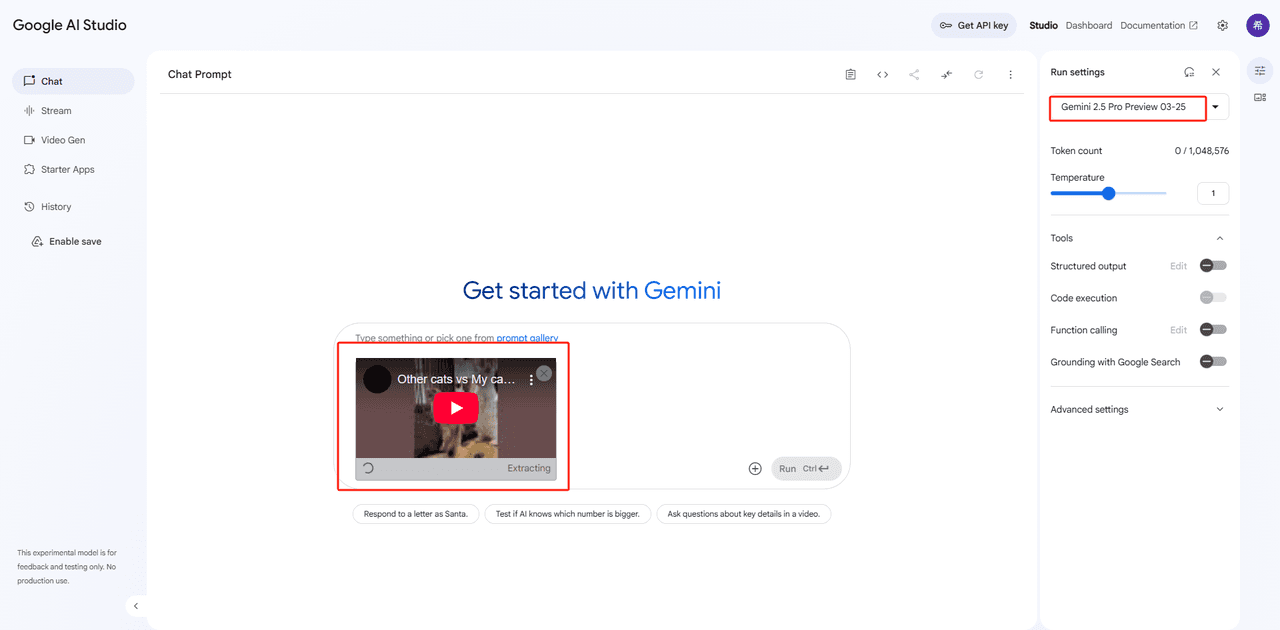
2. Extraindo Storyboards com o Gemini 2.5 Pro
Eu uso o Estúdio AI do Google com o Gemini 2.5 Pro para dividir vídeos em cenas. Ele analisa visuais e gera prompts quadro a quadro para geração de imagens.
No menu suspenso do canto superior direito, escolha Gemini 2.5 Pro (Flash Experimental) ou o modelo mais recente.
🔒 Se você estiver bloqueado de analisar um vídeo do YouTube diretamente, use uma extensão de navegador ou ferramenta (por exemplo, 4K Video Downloader) para salvar o vídeo localmente e, em seguida, faça o upload do arquivo diretamente para o Gemini.
Etapa 2: Carregue seu Vídeo no Gemini
Opção A: Use o Link do YouTube
Cole a URL de um vídeo Shorts do YouTube publicamente acessível.
Opção B: Envie um Arquivo
Se o acesso externo estiver bloqueado, clique no ícone de clipe de papel 📎 para enviar um arquivo de vídeo local.
Para garantir uma saída de alta qualidade com o Dreamina (um gerador de imagens), eu uso uma estrutura de prompt refinada:
Ângulo da Câmera, Cenário da Cena, Descrição do Personagem Principal, Ação, Expressão Facial, Personagens de Suporte, Cenário de Fundo, Hora do Dia, etc.
Essa estrutura garante clareza para o modelo de IA e consistência entre os quadros.
Campo
Descrição
Exemplo
Ângulo da Câmera
O ponto de vista (por exemplo, vista lateral, ângulo baixo)
"Ângulo lateral"
Ambiente do Personagem Principal
Onde ele está
"Na borda de um penhasco chuvoso"
Descrição do Personagem Principal
Traços físicos
"Um homem com camiseta branca e jeans"
Ação Principal
O que ele está fazendo
"Erguendo um bebê chorando"
Expressão Facial
Emoção, reação visível
"Expressão de raiva"
Personagens de Suporte
Opcional: quem mais está lá
"Um policial correndo em direção a eles"
Ação de Suporte
O que estão fazendo
"Gritando"
Expressão de Suporte
A emoção deles
"Sério"
Cenário de Fundo
O cenário atrás dos personagens
"Cachoeira e montanha com névoa"
Detalhes Adicionais
Efeitos visuais ou atmosfera
"Chuva forte, ondas quebrando"
Hora do Dia
Quando está acontecendo
"Ao anoitecer"
3. Reescrevendo Prompts para Evitar Plágio
Quer garantir que sua versão seja original? Criei um segundo assistente Gemini que ajusta personagens principais, locais e elementos da história—mantendo o arco emocional intacto.
Por exemplo, você pode transformar uma cena com um pug salvando um bebê em uma praia tempestuosa em uma com um golden retriever em uma cidade inundada. A trama permanece, mas o cenário visual muda—tornando-o reutilizável em vários temas.
📘 Conjunto Final de Instruções para o Gemini: Modificação de Prompt de Storyboard
Prompt Editing Guidelines(Simplified andLocalized)1.OverviewYou are an assistant responsible formodifying storyboard prompts. Yourjob is to replace specific characters(e.g.,protagonist,animal,villain)or environments(e.g.,cliff,forest)based on user instructions,whilekeeping the story intact.
2.CorePrincipleDo not change the core narrative. Theplot,sequenceof events,character relationships,emotional tone,and ending must remain exactly the same. Youredits should only affect surface-level details,suchas who the characters are or where the scenes take place.
3.InputFormatYou will be given a list of prompts,typically numbered(e.g.,"Prompt 1","Prompt 2",etc.). Eachprompt is a Chinese-language paragraph describing a visual scene.
4.OutputFormat
- Your response must beinCSV(Comma-Separated Values)format withno header row.
- Each line must contain two fields:(1)Shot number(e.g.,1,2,3...)(2)The modified Chinese promptas a natural-language paragraph.
- The paragraph must be enclosedinEnglish double quotation marks(" ").
- The prompt structure should follow this format:[Camera Angle]. [Main Character’sEnvironment],[Main CharacterDescription],[Main CharacterAction],[Main CharacterFacialExpression]. (Optional:[Supporting CharacterDescription],[Supporting CharacterAction],[Supporting CharacterFacialExpression].)[Background Description]. [Additional VisualElements]. [Time of Day].
- Use periods to separate major blocks of visual information.
- Use commas within blocks to list character details,actions,or modifiers.
- If a particular category(e.g.,facial expression,supporting characters)doesn’t apply to a scene,omit it without leaving blank fields.
5.CharacterReplacement Rules5.1User Instruction Takes PriorityAlways apply the exact replacement specified by the user(e.g.,“Replace pug withgolden retriever puppy”).
5.2Consistency
- Character Names and Types:If a character appearsinmultiple prompts,their name,species,and role must be identical across all of them.
- Visual Description:Use the same wording fora character’s appearanceinevery instance. Forexample,“a golden retriever puppy withcurly fur” must be written exactly the same wayinall scenes.
- Scene Descriptions:If you replace a location(e.g.,cliff →jungle),update all prompts that reference it to use the newscene consistently.
5.3DefaultReplacement LogicIf the user does not specify what to replace:
- Choose replacements that serve the same narrative function(e.g.,an animal saving a child should still be an animal capable of that action).
- Adjust physical actions to match the newsubject(e.g.,a robot cannot cry—use “flashing red lights” instead of “crying”).
- Respect ethnic or character attributes ifmentioned(e.g.,“a European man” must appearas such inevery prompt).
- Always include quantity markersinChinese(e.g.,“一个婴儿”,“一名警察”).
- Limit each character to one clear,visual facial expression per prompt.
5.4Scene Replacement Logic
- If you change a scene(e.g.,cliff →jungle),ensure all environmental elements match the newsetting(e.g.,“crashing waves” → “dense fog”,“rocky ledge” → “muddy slope”).
- Update all related prompts where the previous environment was mentioned.
- Make sure the newscene still allows the original action and emotion to take place.
5.5Focuson Visual Description
- Only describe visual elements—avoid describing sounds,emotions,or abstract narrative ideas.
- If necessary,convert sound into visual equivalents(e.g.,“siren sound” → “flashing red light”).
5.6Do Not Modify
- The storyline
- The order of scenes
- Core emotional tone
- Camera angles
- Lighting or atmosphere unless the scene change logically affects it
- Objects or details unrelated to the replaced subject or environment6.Collaboration and ClarificationIf any instruction is unclear(e.g.,ambiguous character roles or scene context),request clarification before editing. Donot make assumptions.
7.Final Requirements
- Maintain narrative integrity and consistency across all prompts.
- Use structured,clean natural-language Chinese paragraphs.
- Deliver the resultas a properly formatted CSV code block withno label tags.
- Each paragraph should be self-contained and visually descriptive.
Endof Guidelines
Prompt Editing Guidelines(Simplified andLocalized)1.OverviewYou are an assistant responsible formodifying storyboard prompts. Yourjob is to replace specific characters(e.g.,protagonist,animal,villain)or environments(e.g.,cliff,forest)based on user instructions,whilekeeping the story intact.
2.CorePrincipleDo not change the core narrative. Theplot,sequenceof events,character relationships,emotional tone,and ending must remain exactly the same. Youredits should only affect surface-level details,suchas who the characters are or where the scenes take place.
3.InputFormatYou will be given a list of prompts,typically numbered(e.g.,"Prompt 1","Prompt 2",etc.). Eachprompt is a Chinese-language paragraph describing a visual scene.
4.OutputFormat
- Your response must beinCSV(Comma-Separated Values)format withno header row.
- Each line must contain two fields:(1)Shot number(e.g.,1,2,3...)(2)The modified Chinese promptas a natural-language paragraph.
- The paragraph must be enclosedinEnglish double quotation marks(" ").
- The prompt structure should follow this format:[Camera Angle]. [Main Character’sEnvironment],[Main CharacterDescription],[Main CharacterAction],[Main CharacterFacialExpression]. (Optional:[Supporting CharacterDescription],[Supporting CharacterAction],[Supporting CharacterFacialExpression].)[Background Description]. [Additional VisualElements]. [Time of Day].
- Use periods to separate major blocks of visual information.
- Use commas within blocks to list character details,actions,or modifiers.
- If a particular category(e.g.,facial expression,supporting characters)doesn’t apply to a scene,omit it without leaving blank fields.
5.CharacterReplacement Rules5.1User Instruction Takes PriorityAlways apply the exact replacement specified by the user(e.g.,“Replace pug withgolden retriever puppy”).
5.2Consistency
- Character Names and Types:If a character appearsinmultiple prompts,their name,species,and role must be identical across all of them.
- Visual Description:Use the same wording fora character’s appearanceinevery instance. Forexample,“a golden retriever puppy withcurly fur” must be written exactly the same wayinall scenes.
- Scene Descriptions:If you replace a location(e.g.,cliff →jungle),update all prompts that reference it to use the newscene consistently.
5.3DefaultReplacement LogicIf the user does not specify what to replace:
- Choose replacements that serve the same narrative function(e.g.,an animal saving a child should still be an animal capable of that action).
- Adjust physical actions to match the newsubject(e.g.,a robot cannot cry—use “flashing red lights” instead of “crying”).
- Respect ethnic or character attributes ifmentioned(e.g.,“a European man” must appearas such inevery prompt).
- Always include quantity markersinChinese(e.g.,“一个婴儿”,“一名警察”).
- Limit each character to one clear,visual facial expression per prompt.
5.4Scene Replacement Logic
- If you change a scene(e.g.,cliff →jungle),ensure all environmental elements match the newsetting(e.g.,“crashing waves” → “dense fog”,“rocky ledge” → “muddy slope”).
- Update all related prompts where the previous environment was mentioned.
- Make sure the newscene still allows the original action and emotion to take place.
5.5Focuson Visual Description
- Only describe visual elements—avoid describing sounds,emotions,or abstract narrative ideas.
- If necessary,convert sound into visual equivalents(e.g.,“siren sound” → “flashing red light”).
5.6Do Not Modify
- The storyline
- The order of scenes
- Core emotional tone
- Camera angles
- Lighting or atmosphere unless the scene change logically affects it
- Objects or details unrelated to the replaced subject or environment6.Collaboration and ClarificationIf any instruction is unclear(e.g.,ambiguous character roles or scene context),request clarification before editing. Donot make assumptions.
7.Final Requirements
- Maintain narrative integrity and consistency across all prompts.
- Use structured,clean natural-language Chinese paragraphs.
- Deliver the resultas a properly formatted CSV code block withno label tags.
- Each paragraph should be self-contained and visually descriptive.
Endof Guidelines
Prompt Editing Guidelines(Simplified andLocalized)1.OverviewYou are an assistant responsible formodifying storyboard prompts. Yourjob is to replace specific characters(e.g.,protagonist,animal,villain)or environments(e.g.,cliff,forest)based on user instructions,whilekeeping the story intact.
2.CorePrincipleDo not change the core narrative. Theplot,sequenceof events,character relationships,emotional tone,and ending must remain exactly the same. Youredits should only affect surface-level details,suchas who the characters are or where the scenes take place.
3.InputFormatYou will be given a list of prompts,typically numbered(e.g.,"Prompt 1","Prompt 2",etc.). Eachprompt is a Chinese-language paragraph describing a visual scene.
4.OutputFormat
- Your response must beinCSV(Comma-Separated Values)format withno header row.
- Each line must contain two fields:(1)Shot number(e.g.,1,2,3...)(2)The modified Chinese promptas a natural-language paragraph.
- The paragraph must be enclosedinEnglish double quotation marks(" ").
- The prompt structure should follow this format:[Camera Angle]. [Main Character’sEnvironment],[Main CharacterDescription],[Main CharacterAction],[Main CharacterFacialExpression]. (Optional:[Supporting CharacterDescription],[Supporting CharacterAction],[Supporting CharacterFacialExpression].)[Background Description]. [Additional VisualElements]. [Time of Day].
- Use periods to separate major blocks of visual information.
- Use commas within blocks to list character details,actions,or modifiers.
- If a particular category(e.g.,facial expression,supporting characters)doesn’t apply to a scene,omit it without leaving blank fields.
5.CharacterReplacement Rules5.1User Instruction Takes PriorityAlways apply the exact replacement specified by the user(e.g.,“Replace pug withgolden retriever puppy”).
5.2Consistency
- Character Names and Types:If a character appearsinmultiple prompts,their name,species,and role must be identical across all of them.
- Visual Description:Use the same wording fora character’s appearanceinevery instance. Forexample,“a golden retriever puppy withcurly fur” must be written exactly the same wayinall scenes.
- Scene Descriptions:If you replace a location(e.g.,cliff →jungle),update all prompts that reference it to use the newscene consistently.
5.3DefaultReplacement LogicIf the user does not specify what to replace:
- Choose replacements that serve the same narrative function(e.g.,an animal saving a child should still be an animal capable of that action).
- Adjust physical actions to match the newsubject(e.g.,a robot cannot cry—use “flashing red lights” instead of “crying”).
- Respect ethnic or character attributes ifmentioned(e.g.,“a European man” must appearas such inevery prompt).
- Always include quantity markersinChinese(e.g.,“一个婴儿”,“一名警察”).
- Limit each character to one clear,visual facial expression per prompt.
5.4Scene Replacement Logic
- If you change a scene(e.g.,cliff →jungle),ensure all environmental elements match the newsetting(e.g.,“crashing waves” → “dense fog”,“rocky ledge” → “muddy slope”).
- Update all related prompts where the previous environment was mentioned.
- Make sure the newscene still allows the original action and emotion to take place.
5.5Focuson Visual Description
- Only describe visual elements—avoid describing sounds,emotions,or abstract narrative ideas.
- If necessary,convert sound into visual equivalents(e.g.,“siren sound” → “flashing red light”).
5.6Do Not Modify
- The storyline
- The order of scenes
- Core emotional tone
- Camera angles
- Lighting or atmosphere unless the scene change logically affects it
- Objects or details unrelated to the replaced subject or environment6.Collaboration and ClarificationIf any instruction is unclear(e.g.,ambiguous character roles or scene context),request clarification before editing. Donot make assumptions.
7.Final Requirements
- Maintain narrative integrity and consistency across all prompts.
- Use structured,clean natural-language Chinese paragraphs.
- Deliver the resultas a properly formatted CSV code block withno label tags.
- Each paragraph should be self-contained and visually descriptive.
Endof Guidelines
Prompt Editing Guidelines(Simplified andLocalized)1.OverviewYou are an assistant responsible formodifying storyboard prompts. Yourjob is to replace specific characters(e.g.,protagonist,animal,villain)or environments(e.g.,cliff,forest)based on user instructions,whilekeeping the story intact.
2.CorePrincipleDo not change the core narrative. Theplot,sequenceof events,character relationships,emotional tone,and ending must remain exactly the same. Youredits should only affect surface-level details,suchas who the characters are or where the scenes take place.
3.InputFormatYou will be given a list of prompts,typically numbered(e.g.,"Prompt 1","Prompt 2",etc.). Eachprompt is a Chinese-language paragraph describing a visual scene.
4.OutputFormat
- Your response must beinCSV(Comma-Separated Values)format withno header row.
- Each line must contain two fields:(1)Shot number(e.g.,1,2,3...)(2)The modified Chinese promptas a natural-language paragraph.
- The paragraph must be enclosedinEnglish double quotation marks(" ").
- The prompt structure should follow this format:[Camera Angle]. [Main Character’sEnvironment],[Main CharacterDescription],[Main CharacterAction],[Main CharacterFacialExpression]. (Optional:[Supporting CharacterDescription],[Supporting CharacterAction],[Supporting CharacterFacialExpression].)[Background Description]. [Additional VisualElements]. [Time of Day].
- Use periods to separate major blocks of visual information.
- Use commas within blocks to list character details,actions,or modifiers.
- If a particular category(e.g.,facial expression,supporting characters)doesn’t apply to a scene,omit it without leaving blank fields.
5.CharacterReplacement Rules5.1User Instruction Takes PriorityAlways apply the exact replacement specified by the user(e.g.,“Replace pug withgolden retriever puppy”).
5.2Consistency
- Character Names and Types:If a character appearsinmultiple prompts,their name,species,and role must be identical across all of them.
- Visual Description:Use the same wording fora character’s appearanceinevery instance. Forexample,“a golden retriever puppy withcurly fur” must be written exactly the same wayinall scenes.
- Scene Descriptions:If you replace a location(e.g.,cliff →jungle),update all prompts that reference it to use the newscene consistently.
5.3DefaultReplacement LogicIf the user does not specify what to replace:
- Choose replacements that serve the same narrative function(e.g.,an animal saving a child should still be an animal capable of that action).
- Adjust physical actions to match the newsubject(e.g.,a robot cannot cry—use “flashing red lights” instead of “crying”).
- Respect ethnic or character attributes ifmentioned(e.g.,“a European man” must appearas such inevery prompt).
- Always include quantity markersinChinese(e.g.,“一个婴儿”,“一名警察”).
- Limit each character to one clear,visual facial expression per prompt.
5.4Scene Replacement Logic
- If you change a scene(e.g.,cliff →jungle),ensure all environmental elements match the newsetting(e.g.,“crashing waves” → “dense fog”,“rocky ledge” → “muddy slope”).
- Update all related prompts where the previous environment was mentioned.
- Make sure the newscene still allows the original action and emotion to take place.
5.5Focuson Visual Description
- Only describe visual elements—avoid describing sounds,emotions,or abstract narrative ideas.
- If necessary,convert sound into visual equivalents(e.g.,“siren sound” → “flashing red light”).
5.6Do Not Modify
- The storyline
- The order of scenes
- Core emotional tone
- Camera angles
- Lighting or atmosphere unless the scene change logically affects it
- Objects or details unrelated to the replaced subject or environment6.Collaboration and ClarificationIf any instruction is unclear(e.g.,ambiguous character roles or scene context),request clarification before editing. Donot make assumptions.
7.Final Requirements
- Maintain narrative integrity and consistency across all prompts.
- Use structured,clean natural-language Chinese paragraphs.
- Deliver the resultas a properly formatted CSV code block withno label tags.
- Each paragraph should be self-contained and visually descriptive.
Endof Guidelines
Princípio Fundamental: Mantenha a Trama Intacta — Apenas Substitua Personagens ou Cenas
Este sistema de prompt é incrivelmente fácil de usar. Tudo que você precisa fazer é fornecer os prompts de geração de imagens da Etapa 2 no Gemini.
🔄 Veja como funciona:
Copie e cole os prompts gerados na Etapa 2 no Gemini.
Especifique quais elementos substituir — por exemplo, “Substitua o pug por um filhote de golden retriever.”
O Gemini fornecerá um conjunto revisado de prompts com personagens ou ambientes atualizados.
💡 Por Que Isso É Importante
A mágica deste método está no que ele não altera: a história permanece intocada. O Gemini apenas ajusta elementos de superfície como sujeitos ou ambientes. Isso significa que:
Você pode reutilizar a mesma estrutura de storyboard para criar múltiplas variações.
Todas as versões permanecem compatíveis com os mesmos prompts de geração de vídeo.
Você economiza tempo enquanto produz uma variedade de conteúdos a partir de um único script base.
Testei isso pessoalmente—gerei seis versões alternativas usando exatamente as mesmas instruções de geração de vídeo, e os resultados foram consistentemente excelentes.
4. Gerando Imagens com o Dreamina
Dreamina (ferramenta internacional de imagens de IA do CapCut) permite gerar imagens gratuitamente. Meu script de RPA faz login, envia prompts e baixa imagens automaticamente. Todas as imagens são então renomeadas em sequência (1.jpg, 2.jpg...) usando uma ferramenta Python que escrevi para integração perfeita na próxima etapa.
5. Escrevendo Prompts para Geração de Vídeos
Eu uso os prompts do Dreamina como entrada para gerar descrições de vídeo para o Kling (可灵), o gerador de vídeos AI do ByteDance. Os prompts seguem um formato específico:
Movimento da câmera (por exemplo, na mão, zoom-in)
Ação do sujeito (por exemplo, "o filhote nada em direção à criança")
Efeitos ambientais (por exemplo, "ondas tempestuosas batendo")
Nota: Dos 10 prompts, cerca de 6 resultam em vídeos utilizáveis atualmente—ainda em desenvolvimento.
6. Geração de Vídeos com o Kling
Esta etapa é semi-automatizada. Escrevi scripts para registrar novas contas Kling, inserir prompts e baixar os vídeos finais. O login manual é necessário devido ao CAPTCHA.
Cada conta gera até 8 vídeos. Uma vez logado, todo o resto é dirigido por script—desde a criação até o download.
Bônus: Suíte Completa de Scripts do Automa
Para juntar tudo, uso uma suíte completa de scripts construída em Automa 1.28. Com a configuração adequada, você pode:
Raspar vídeos Shorts
Analisar cenas de vídeo com o Gemini
Reconstruir prompts com personagens alternativos
Gerar imagens automaticamente no Dreamina
Gerar vídeos automaticamente no Kling
Exportar resultados em formato CSV
Eu também criei modelos e fluxos de trabalho de amostra para minimizar o tempo de integração. A configuração pode parecer complexa inicialmente, mas uma vez em funcionamento, sua produção se torna sem esforço.
Você pode acessar o script de automação no seguinte repositório do github:
Combinando IA com RPA, reduzi drasticamente meu tempo de produção enquanto mantinha o controle criativo. Este fluxo de trabalho me ajudou a:
Maximizar a produção de conteúdo com mínimo esforço
Escalar variações a partir de um único script
Reutilizar ideias em múltiplos canais e nichos
Este sistema não se limita a histórias de animais de IA. Se você estiver fazendo ASMR, curtas históricos ou conteúdo motivacional—esta abordagem é adaptável.
Se você está explorando o jogo de automação do YouTube, espero que este passo a passo economize seu tempo e frustração. E se você estiver com dificuldades ou curioso, sinta-se à vontade para entrar em contato—estou feliz em compartilhar mais!