What Makes AI-Generated Subtitles Feel Truly Professional?

Addsubtitle Team
Add Subtitle gives brands and creators full control over how their message meets the world. Subtitles, voiceover, and translation—all in one tool to speed up your video workflow.
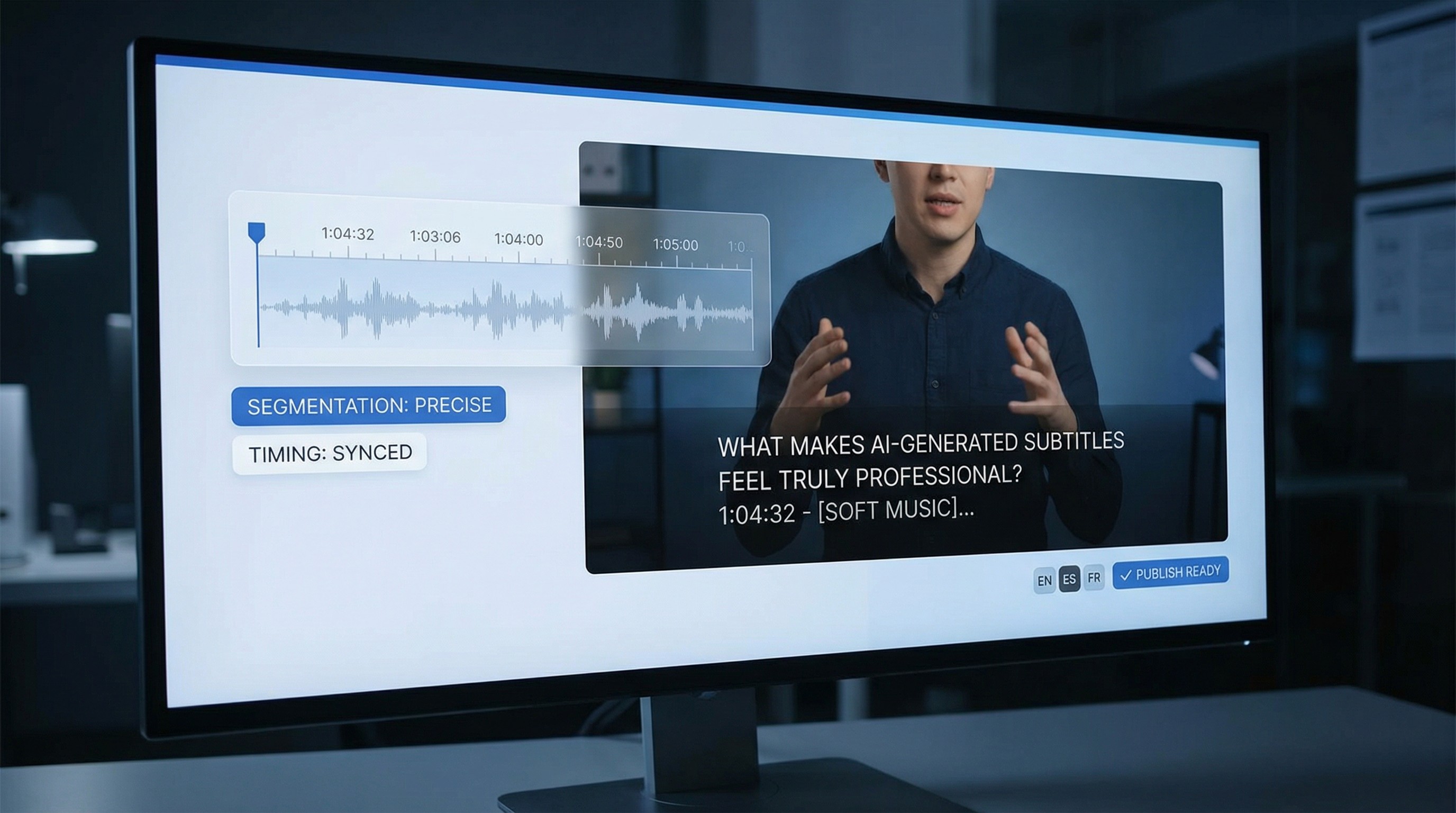
AI-generated subtitles have become fast, accessible, and widely available. But speed alone does not create a professional viewing experience. Many subtitle outputs are technically correct while still feeling awkward, cluttered, mistimed, or difficult to follow. The difference between “machine-generated subtitles” and “professional-feeling subtitles” is no longer just accuracy. It is readability, timing, segmentation, consistency, and delivery quality. As AI subtitle tools mature, the next real standard is not whether subtitles can be produced automatically, but whether they can feel polished enough to publish with confidence.
Truly effective subtitles need to feel natural, readable, consistent, and ready to publish with minimal cleanup. In the early stage of AI subtitle adoption, speed was the headline benefit. But as the market matures, users are asking a more important question: can AI subtitle tools produce results that already feel professional on screen? That shift is changing how subtitle quality is judged across creators, media teams, and global brands.
AI subtitle tools have become fast, but speed alone is no longer enough. The next real standard is publish-ready quality: subtitles that are readable, well-timed, well-segmented, and consistent enough to feel professional with minimal manual editing.
AI subtitle technology has improved rapidly over the past few years. What once required labor-intensive manual transcription can now be done in minutes. For creators, media teams, and global businesses, that efficiency has changed the economics of subtitle production. But as the technology matures, the definition of quality is also changing.
Generating subtitles is not the same as producing subtitles that feel professional on screen. Professional subtitle quality depends on much more than word recognition. Timing, segmentation, punctuation, line balance, readability, and consistency all shape how subtitles are experienced by viewers. If text appears too quickly, breaks in unnatural places, or overloads the screen, even an accurate transcript can still feel distracting and low quality.
Segmentation is one of the clearest signals of subtitle professionalism. Well-segmented subtitles follow natural language boundaries and help viewers process meaning smoothly. Poor segmentation creates friction by forcing viewers to re-read or mentally restructure the text while also trying to follow the video. This is one reason many AI-generated subtitles still require editorial correction before they are suitable for real publishing use.
Timing is another critical layer. Good subtitles do not simply match speech at a technical level. They also support reading comfort. Viewers need enough time to read without falling behind the speaker or missing visual context. Professional subtitles feel calm, intentional, and synchronized with both speech and attention.
Consistency also matters more than many teams realize. In professional content environments, subtitle formatting reflects the quality of the overall brand. Inconsistent capitalization, unstable punctuation, uneven line length, and unpredictable display rhythm all reduce trust in the final product. For businesses and media teams, subtitle output is not just a utility layer. It is part of the audience experience.
If you are evaluating AI subtitle tools, look beyond transcription speed and ask a more important question: how close is the output to publish-ready quality? The future of AI subtitling belongs to workflows that combine automation with readability, timing, consistency, and delivery confidence.
It's Free