Why AI Video Models Suddenly Became the Hottest Topic—And Why Addsubtitle Is Part of the Real Opportunity

Addsubtitle Editorial Team
Add Subtitle gives brands and creators full control over how their message meets the world. Subtitles, voiceover, and translation—all in one tool to speed up your video workflow.

AI video generation has quickly become one of the hottest topics in generative AI. New model releases, viral demos, and nonstop discussion around realism, controllability, and production quality have pushed the category into the spotlight. But for brands and growth teams, the real opportunity is not just generating more video faster. It is turning that video into content people can actually understand, localize, and publish at scale. That is where Addsubtitle becomes important.
Why AI Video Models Suddenly Became the Hottest Topic—And Why Addsubtitle Is Part of the Real Opportunity
AI video generation has quickly become one of the hottest topics in generative AI. New model releases, viral demos, and nonstop discussion around realism, controllability, and production quality have pushed the category into the spotlight. But for brands and growth teams, the real opportunity is not just generating more video faster. It is turning that video into content people can actually understand, localize, and publish at scale. That is where Addsubtitle becomes important.
Over the past year, generative AI has moved in waves.
Text drew the first wave of mass attention. Image generation proved that creative production could accelerate dramatically. Audio tools began reshaping voice and sound workflows. Now video is becoming the next major focus because it sits closest to commercial content demand.
That is why AI video feels different from many earlier AI trends. Video is already the dominant format across social media, product marketing, ecommerce storytelling, creator growth, and international content distribution. So when video generation models improve, the market does not just see a technical milestone. It sees a possible shift in how brands create and scale content.
That explains the heat around the category.
But it also creates a familiar risk: people start treating the most visible layer of the trend as the whole story.
Right now, most of the conversation is about generation quality.
The more practical question is what happens after generation.
Why AI video has become such a hot topic
The current momentum around video generation is being driven by both attention logic and business logic.
From an attention perspective, AI video demos spread fast. They are visual, immediate, and easy for the market to react to. People do not need much explanation to understand why a more realistic clip, smoother motion sequence, or stronger prompt response matters.
From a business perspective, the demand is obvious.
Brands and content teams need:
more short-form video
more campaign variations
more product explainers
more ad creatives
more localized content versions
faster turnaround with less production friction
Traditional production remains powerful, but it is expensive in time, coordination, and revision cost. AI video models are attracting attention because they promise a faster starting point: more concepts, more iterations, and more output without rebuilding every asset from scratch.
That is why every new model release gets discussed so intensely. The market is not just comparing demos. It is testing the idea that video production could become much more scalable.
What the hype is really telling us
When a category suddenly becomes “hot,†that usually means the market believes it may unlock a real workflow shift.
That is exactly what is happening in AI video.
The hype is signaling four things at once:
1. The quality barrier is becoming less of a blocker
Generated video is still imperfect, but it is improving enough that businesses can imagine real use cases.
2. Video has direct commercial value
Unlike some AI categories that feel experimental, video immediately maps to advertising, social content, education, and conversion.
3. Content demand keeps rising
Teams do not just need one good video. They need many versions, across many channels, often under heavy time pressure.
4. Distribution is becoming a bigger challenge than creation alone
Once teams can generate more video, the next bottleneck is no longer “Can we make it?†but “Can we deploy it effectively?â€
That fourth point is where the conversation starts to matter for Addsubtitle.
The industry is still over-focused on the generation layer
Most current discussions still revolve around questions like:
Which model looks best?
Which one produces more realistic motion?
Which one gives users better prompt control?
Which one feels more cinematic or polished?
Those questions matter, but they only evaluate the first half of the workflow.
For real publishing, a generated clip still has to pass a much harder test.
It has to work in the environments where audiences actually consume content:
mobile feeds
sound-off viewing situations
multilingual markets
fast-scroll social platforms
brand publishing systems
conversion-focused campaign pages
A strong-looking AI video can still underperform if users do not understand the message quickly enough.
That is why the market will eventually care less about raw generation novelty and more about workflow readiness.
Why subtitles become more important as AI video scales
This is the practical shift underneath the hype.
As video generation gets easier, brands can produce more video assets.
But producing more assets creates more pressure on the layers that make those assets usable.
That includes:
subtitle generation
readable caption formatting
multilingual translation
localization workflow
accessibility support
publish-ready delivery
So better AI video generation does not reduce the need for subtitle tools.
It increases the need.
That is why Addsubtitle becomes more valuable as the AI video category gets hotter.
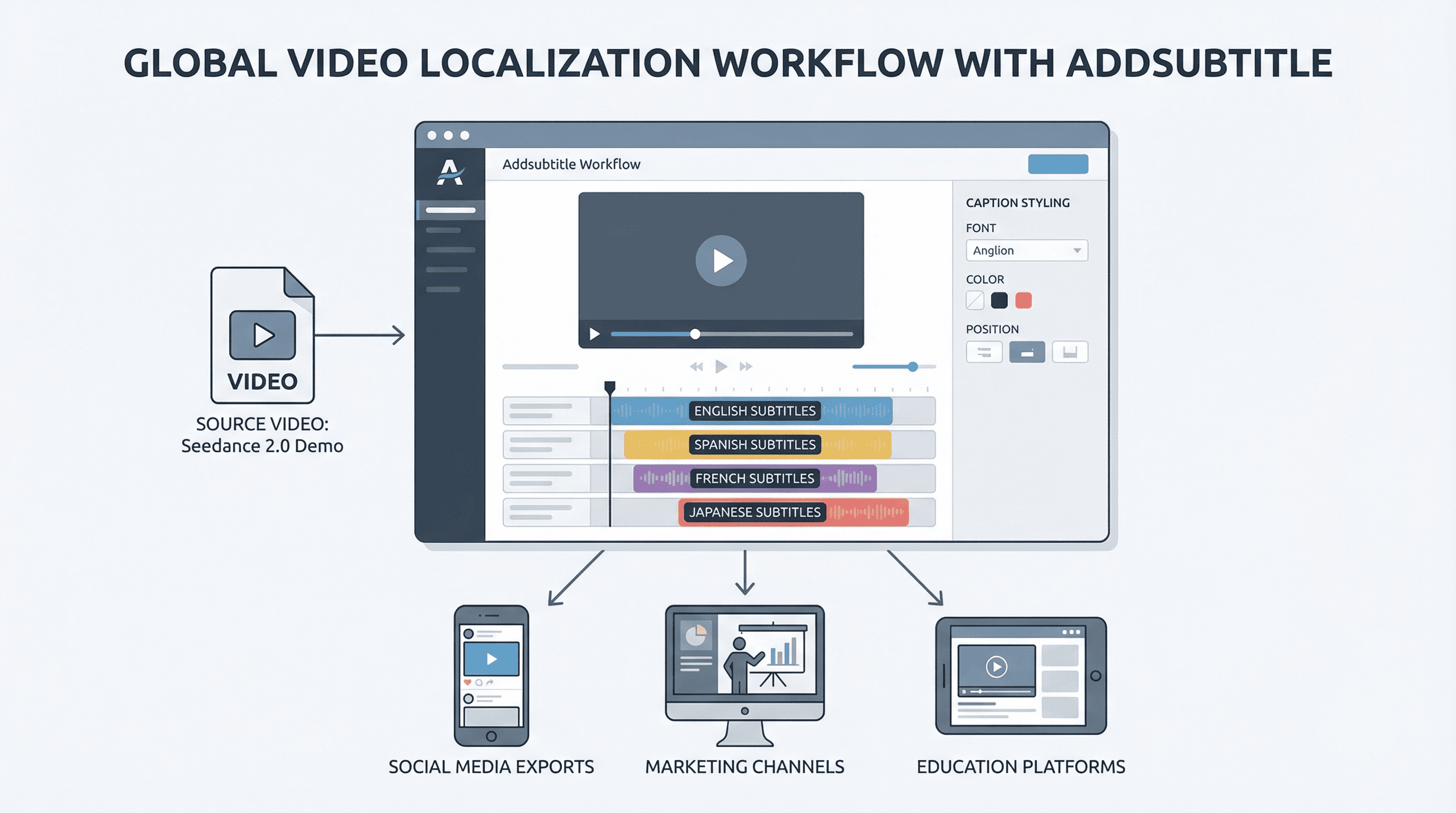
Why Addsubtitle is relevant to this trend
Addsubtitle fits naturally into the post-generation part of the workflow—the stage where video moves from “generated output†to “usable content asset.â€
For brands, that matters because a video only creates value when people can understand it, engage with it, and reuse it across markets.
This is where Addsubtitle helps.
1. It makes AI-generated video easier to understand in real viewing conditions
A large share of online video starts with the sound off. On short-form platforms especially, users decide in seconds whether to keep watching.
Readable subtitles help the message land immediately. For brands, that means generated video is less likely to lose effectiveness in the exact environments where distribution matters most.
2. It makes multilingual expansion more practical
AI video generation can increase content supply, but global growth still depends on language accessibility.
Addsubtitle helps teams subtitle and adapt videos for more markets without turning every localization task into a manual production cycle.
That makes one generated asset more reusable and more commercially efficient.
3. It helps teams move from content creation to content deployment
This is one of the biggest gaps in the current AI video conversation.
Generating a clip is not the same as having a campaign-ready asset.
To become publish-ready, a video often needs:
clear subtitle text
readable pacing and line breaks
better accessibility for more viewers
versions that work across languages and channels
Addsubtitle helps reduce that gap.
4. It increases the return on generated content
For a brand team, the value of a video is not only in how quickly it was created. It is in how far it can go.
If one video can be made easier to understand, easier to localize, and easier to reuse across multiple publishing contexts, then the ROI of that asset improves.
That is why Addsubtitle should be seen as part of growth infrastructure, not just a finishing tool.
The better way to frame the market

The strongest framing is this:
AI video models create more content supply. Addsubtitle helps that content perform across more channels, languages, and audience contexts.
That is the real opportunity for brands.
Generation matters because it lowers production friction.
Addsubtitle matters because it improves communication efficiency.
Together, they create a more complete workflow:
generate video faster
make it understandable faster
localize it more efficiently
deploy it more broadly
That is a much more commercially useful story than generation alone.
Why this matters for brand and growth teams
For brand teams, AI video can increase campaign velocity.
For growth teams, it creates more room for testing different hooks, formats, and audience messages.
For international teams, it creates more opportunities to scale a single content concept across regions.
But none of that works well if the content remains hard to understand, limited to one language, or weak in sound-off environments.
This is why subtitle workflow is becoming strategically important.
Addsubtitle helps teams get more usable value out of every generated asset by supporting the part of the funnel where content becomes accessible, localized, and deployment-ready.
Conclusion
AI video generation models have become a hot topic because they combine visible technical progress with obvious business upside. The market sees the possibility of faster, cheaper, and more scalable video creation.
That explains the hype.
But for brands, the real opportunity is bigger than generation itself.
As more AI video gets produced, the winners will not only be the teams that can generate content quickly. They will be the teams that can turn generated video into clear, localized, publish-ready assets that travel across platforms and markets.
That is why Addsubtitle belongs in this conversation.
AI video may create the asset.
Addsubtitle helps turn it into a working distribution asset.
And for brand publishing, that difference is where much of the real value is created.
It's Free