Sora Is Dead. The AI Video Wars Just Got Real.

Legendary Writer
Add Subtitle gives brands and creators full control over how their message meets the world. Subtitles, voiceover, and translation—all in one tool to speed up your video workflow.

Sora going away is not just another product update. It is a market-reset moment for AI video, and it immediately changes which companies, creators, and platforms have the most to gain.
Sora Is Dead. The AI Video Wars Just Got Real.
Sora is gone. And instead of cooling down the AI video market, that may have made it significantly more intense.
For months, Sora functioned like a gravitational center in the AI video conversation. Even when people were not using it, they were measuring everything against it. It helped define the category’s ambition, its aesthetic ceiling, and its media narrative.
Now that center has collapsed.
And when the center collapses in a fast-moving market, two things happen at once: attention scatters, and competitors sprint.
That is what makes this moment bigger than a single shutdown story.
It is not just about Sora disappearing.
It is about the AI video field suddenly becoming more open, more aggressive, and more commercially interesting.
Caption: Sora’s exit does not end the hype cycle. It creates a more chaotic and more competitive one.
The market lost its headline product
Sora was never just a tool.
It was a symbol.
It represented the idea that AI video could move from uncanny experiment to premium media format. It gave the market a flagship. It gave headlines something to orbit. It gave competitors a benchmark to attack.
That is why its exit matters far beyond current users.
A flagship product disappearing does not create a vacuum in demand. Demand stays exactly where it is. If anything, it becomes more urgent. The creators still need tools. The brands still need video. The growth teams still need more output, faster. The platforms still need content that looks like the future.
What disappears is the illusion that one name owns the narrative.
That changes everything.
This is the phase where categories get real
There is a pattern in every major AI market.
First comes fascination.
Then comes benchmark obsession.
Then comes the moment when buyers stop asking who had the best demo and start asking who can actually win the workflow.
AI video may have just entered that third phase.
Sora’s shutdown forces the category to mature faster. It shifts the discussion away from prestige and toward replacement. Away from mythology and toward product fit. Away from “look what’s possible” and toward “what should we use on Monday?”
That is a much more serious question.
And it tends to produce much clearer winners.
So who benefits now?
The short answer is: anyone still standing with a credible product and enough momentum to capture displaced attention.
But not all alternatives are equally positioned.
Some tools look better in demos. Some look better in strategy decks. Some look better once a real content team sits down and tries to make ten usable assets in a week.
That is the difference that matters now.
Runway looks like the most obvious immediate winner
If this market suddenly needs a default replacement, Runway has one major advantage: it already feels like a serious product business, not just a moment.
That matters because shutdowns change buyer psychology. Once a headline product disappears, people become more sensitive to reliability. They want something that feels operational, not mythical.
Runway fits that mood well.
It already has strong recognition with creative teams. It already feels embedded in real workflows. It already makes sense to agencies, brands, and teams that want something more durable than a flashy experiment.
In other words, if the market wants an answer right now, Runway is the easiest answer to give.
Not because it is the only contender.
Because it is the contender that most naturally absorbs “we need a serious replacement” energy.
Veo may be the most dangerous long-game player
If Runway is the immediate winner, Veo may be the one that matters most over time.
Google does not enter markets lightly when it thinks the category matters strategically. And AI video clearly matters. It sits too close to search, ads, productivity, creator ecosystems, and next-generation media workflows to be treated as a side project.
That gives Veo a very different kind of power.
It does not just have to impress people with output. It can win by becoming infrastructure. It can win by being inside bigger systems. It can win by looking like the safest bet for large organizations that do not want to build content strategy around a fragile narrative.
That is why Veo may be the most threatening company in the room even when it is not the noisiest one.
Kling has exactly the kind of momentum that can explode after a reset
Every time a category leader weakens, the market starts scanning for the tool with breakout energy.
Kling has a real chance to be that tool.
It already carries the kind of demo appeal that makes creators curious. It already benefits from the broader appetite for alternatives. And it already feels like one of the products most likely to gain from a market that suddenly becomes more fluid.
That fluidity matters.
When users are no longer anchored to a single “main character,” they become much more willing to test, post, compare, and migrate. That creates a powerful feedback loop for any tool with enough visual punch to spread socially.
Kling looks built for exactly that kind of moment.
Pika still understands something the market keeps undervaluing
The AI industry loves prestige rankings.
Actual creators often care more about speed.
That is why Pika remains more relevant than the model discourse sometimes suggests.
Pika does not need to win every cinematic benchmark to win real usage. It only needs to help people move faster, experiment more cheaply, and keep content production flowing. In a world where teams need more variations, more motion assets, more social output, and less friction, that is not a minor advantage. It is a category-level advantage.
There is a reason creator-friendly tools survive hype cycles better than people expect. They do something useful before they do something legendary.
Pika still fits that pattern.
Luma benefits from one very simple reality: the market is testing again
Whenever a flagship product exits, everyone reopens the shortlist.
That alone helps Luma.
Tools that may have been overshadowed by the biggest narrative can suddenly become more visible when buyers start running fresh comparisons. And Luma remains one of the names most likely to show up in those comparisons, especially for users who care about motion, visual quality, and overall aesthetic feel.
That may not sound dramatic.
But in a reset market, shortlist presence is power.
The wrong way to think about replacement
A lot of the “Sora alternatives” conversation will get flattened into a simple ranking format.
That is useful for clicks, but not enough for decision-making.
The real replacement question is not “Which model looks most like Sora?”
It is “Which product makes the most sense for the kind of work we actually need to do?”
That includes generation quality, yes.
But it also includes speed, consistency, editing flexibility, export usefulness, collaboration fit, and how easily the result can move into a publishable workflow.
That is where a lot of the romance drains out of the category.
And that is also where the actual winners emerge.

Caption: The best post-Sora product will not just generate impressive clips. It will survive contact with real production workflows.
What this changes for the AI video market
The obvious takeaway is that the competition just got tighter.
But the more interesting takeaway is that the category may now become healthier.
When one product dominates the media story, the market can become strangely passive. Everyone watches. Everyone compares. Everyone waits. Once that focal point disappears, the rest of the market has to move. Faster releases. Sharper positioning. Clearer workflow stories. Better pricing logic. More aggressive product differentiation.
That is good for users.
And it is good for content.
Because the next phase of AI video will not be won by the tool with the most myth around it.
It will be won by the tool that best combines output quality with practical usefulness.
The next AI video default has not been chosen yet
That is the real story here.
Sora’s exit does not hand the crown neatly to one company. It turns the market into a fight.
Runway looks like the most natural immediate inheritor.
Veo looks like the biggest strategic threat.
Kling looks like the product most likely to absorb momentum.
Pika looks like the speed play creators will keep using.
Luma looks like the benchmark alternative serious evaluators will keep testing.
None of that means the market is settled.
It means the market is finally contested in a more honest way.
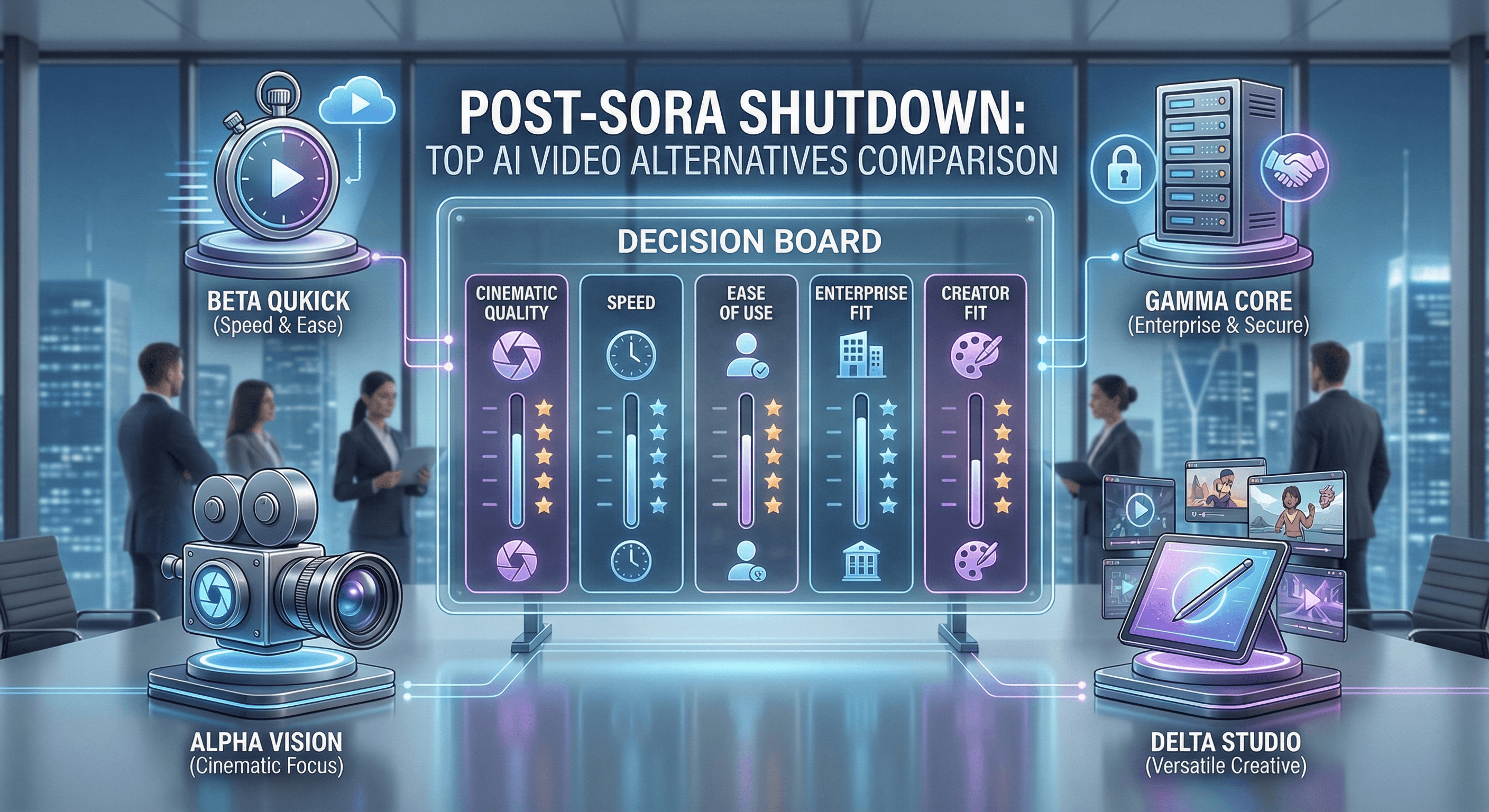
Caption: Sora’s disappearance does not reduce competition. It forces the field to compete for the next default position.
Final take
Sora is dead.
The category is not.
If anything, AI video just became more dangerous, more competitive, and more relevant.
Because once the flagship disappears, every serious alternative gets a shot at becoming the new default — and every buyer is forced to stop watching the narrative and start choosing the product.
That is when markets stop being theatrical and start being real.
The AI video wars were always coming.
Sora’s exit just made them impossible to ignore.
It's Free